
Is 2026 The Right Time To Build, Or Should You Wait?
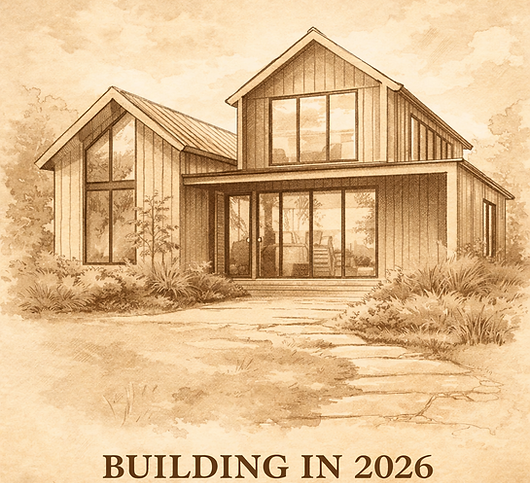
Thinking about a home extension or new build in 2026? This guide explains whether to build now or wait, covering costs, borrowing, and how to make a confident decision.
SUMMARY:
Many clients are asking whether they should press ahead with a home extension or new build, or wait for more certainty. The reality is more balanced than headlines suggest. Costs are likely to rise gradually, but borrowing and confidence are the bigger short-term factors.
WHY THIS QUESTION IS COMING UP NOW
Over the past few months, concerns around global events, particularly in the Middle East, have started to filter into everyday conversations about building projects.
Clients are understandably asking:
Are construction costs about to rise again?
Should we delay until things settle down?
Is now a risky time to commit?
There is some truth behind these concerns, but much of what is being shared is simplified or accelerated. To make a clear decision, it helps to step back and look at what credible UK sources are actually saying.
Since Covid, the Ukraine war and the resulting energy crisis, UK construction costs have increased significantly, with many materials and overall build costs rising by around 30–40% compared to pre-2020 levels, largely driven by higher energy, manufacturing and labour costs.
WHAT THE DATA IS TELLING US (NOT THE HEADLINES)
BUILD COSTS: RISING, BUT NOT SPIKING
The Building Cost Information Service (BCIS) provides one of the most reliable views of the UK construction market.
Their recent outlook is clear:
Costs are expected to continue rising gradually, not sharply
The industry is currently fragile rather than overheated
Demand remains relatively weak, which is limiting sudden price increases
A key takeaway from BCIS is:
“The effects are expected to emerge over time rather than immediately.”
In simple terms, there is no evidence of an immediate cost surge, but there is steady upward pressure over time.
BORROWING: THE BIGGER SHORT-TERM FACTOR
The Bank of England sets the base interest rate, which directly influences mortgages and borrowing.
As of 2026:
Interest rates remain relatively high
Inflation is still above the long-term target
The Bank is cautious about reducing rates too quickly
A simple way to understand this is:
Inflation is like a fire, and interest rates are the water used to put it out.
The Bank has turned the water on, but it is not yet confident the fire is fully out. That is why rates are staying higher for longer.
For clients, this means:
Borrowing is currently more expensive than in recent years
Monthly affordability is often the main constraint
Small changes in rates can significantly affect project viability
WHAT INDEPENDENT, CLIENT-FOCUSED SOURCES SAY
For a more practical perspective, MoneySavingExpert explains that mortgage rates are influenced by expectations of the future, not just today’s base rate.
This creates a situation where:
Rates can move quickly
Certainty is limited
Clients feel understandably cautious
This aligns with wider industry feedback from RICS and CPA:
Confidence has softened
Some projects are being delayed or reduced in scope
Affordability is often the deciding factor
IS THE MEDIA OVERSTATING THINGS?
There is some exaggeration in how this is being presented publicly.
A common narrative is:
“War equals rising building costs.”
The reality is more measured:
Global events can affect energy prices
Energy influences material costs
But this takes time to filter through
The risk is not immediate spikes, but gradual pressure over time.
It is important not to make decisions based on short-term headlines or knee-jerk reactions.
SO… SHOULD YOU BUILD NOW OR WAIT?
There is no one-size-fits-all answer, but there is a clear way to approach the decision.
BUILDING NOW
Advantages:
Greater certainty on current costs and programme
Ability to fix prices and secure contractors
Progress towards long-term goals
Risks:
Borrowing costs are currently higher
Some cost inflation may still occur during the project
WAITING
Advantages:
Potential for borrowing costs to ease
More time to plan and refine
Risks:
Build costs are likely to continue rising gradually
Ongoing uncertainty in both costs and borrowing
Delayed lifestyle or space improvements
THE MOST IMPORTANT POINT
Waiting does not remove risk. It simply changes the type of risk.
A PRACTICAL WAY TO DECIDE
The most helpful questions to ask are:
Is this project driven by need or timing?
How comfortable does the borrowing feel today?
Would delaying materially change your situation?
In many cases:
If the project is needed and affordable, progressing is sensible
If affordability is tight, adjusting scope is often better than delaying entirely
HOW TO PROTECT YOUR PROJECT IF YOU PROCEED
If you do decide to move forward, good planning becomes even more important.
Key recommendations:
Develop the design thoroughly before tender
Obtain detailed and coordinated building regulations drawings
Secure fixed prices where possible
Lock in key high-value packages early, particularly:structural elements
windows and doors, roofing and other major materials
Allow for a sensible contingency (typically 10–15%)
This approach reduces exposure to future cost changes and gives greater control.
A FINAL THOUGHT ON ENERGY AND LONG-TERM VALUE
One of the consistent threads running through all of this is energy.
Much of the uncertainty in both inflation and construction costs ultimately links back to energy supply and pricing.
For homeowners, this reinforces a simple but important point:
Investing in good insulation and overall fabric performance is one of the most reliable ways to protect your home from future cost increases.
A well-insulated, well-designed home:
reduces ongoing energy bills
improves comfort
adds long-term resilience against rising energy costs
Regardless of timing, this is rarely a wasted investment.
FINAL THOUGHTS
The current market is best described as cautious rather than volatile.
Costs are likely to rise gradually over time
Borrowing remains the main short-term challenge
There is no clear advantage to waiting purely based on market timing
The right decision ultimately depends on your circumstances, priorities, and comfort with risk.
SOURCES AND FURTHER READING
Building Cost Information Service
Bank of England
MoneySavingExpert
Royal Institution of Chartered Surveyors
Construction Products Association
If you’re planning a home extension or new build and want to sense-check your approach, feel free to get in touch.
DISCLAIMER
This article is provided as general guidance only and does not constitute legal or professional advice. Always seek tailored advice specific to your project or situation.
